Local Networks and TCP/IP Fundamentals Training Course
Key information
Upcoming sessions
Would you like to schedule this training on a specific date? Contact us by email or via the contact form.
Description of the training: Local Networks and TCP/IP Fundamentals Training Course
This Local Networks and TCP/IP Fundamentals training course prepares IT professionals to understand, design and troubleshoot modern computer network architectures. You will learn to master the OSI and TCP/IP models, configure IP addressing and subnetting, implement core network protocols and diagnose connectivity issues. The programme covers LAN/WAN fundamentals, Ethernet switching, routing basics, DHCP, DNS and network diagnostic tools. By the end, you will be able to design and administer reliable network infrastructures. Hands-on labs and real-world network scenarios are at the core of this training. Also discover our Network Administration (Switching and Routing) Training Course, our CCNA Cisco 200-301 training, our Routing and Firewalling training and our Wi-Fi and Mobility Technologies training.
Good to know
This course includes numerous exercises (60% hands-on practice) for better learning. Sessions are guaranteed from a single registrant (except in cases of force majeure). A preliminary interview takes place between the participant and/or a company representative in order to fully take into account the participant’s profile (level, needs, professional context, challenges, etc.).
Assessment: during the training, the trainer assesses participants’ learning progress through quizzes, role-play and hands-on exercises. Participants receive a certificate of completion at the end of the course.
This course is part of our Computer Network Training Courses catalogue. Explore our other networking trainings to design, configure and operate reliable network infrastructures.
Objectives of the training: Local Networks and TCP/IP Fundamentals Training Course
By the end of the course, the participant will be able to:
- Understand the fundamentals of local (LAN) and wide-area (WAN/MAN) networks, as well as interconnection concepts, to structure and diagnose infrastructures
- Master the OSI model, the various transmission technologies and interconnection devices (switch, router, bridge)
- Configure an IP address, subnet mask and gateway, and use core services such as DHCP and DNS
- Describe the TCP/IP model, understand the associated protocols (IP, TCP, UDP, ICMP) and their role in network communication
- Use the main testing and troubleshooting tools (ping, traceroute, etc.) to diagnose a network
Prerequisites of the training: Local Networks and TCP/IP Fundamentals Training Course
- Basic knowledge of computing and operating systems (Windows, Linux) to follow the networking concepts easily
- No advanced technical prerequisites are required; some initial familiarity with simple networks is a plus
Because every participant is unique, a personalised interview with our expert allows us to design a course perfectly aligned with their objectives, level and professional challenges.
Target audience of the training: Local Networks and TCP/IP Fundamentals Training Course
Network or systems technicians and administrators who install, configure or troubleshoot local or IP networks. IT support engineers, or anyone wishing to strengthen their understanding of TCP/IP and LAN networks.
Detailed programme of the training: Local Networks and TCP/IP Fundamentals Training Course
Introduction to networks
Transmission media and switching
OSI model and encapsulation
Protocols and IEEE standards
Introduction to TCP/IP
Network configuration and services
Routing and practical concepts
Diagnostic and troubleshooting tools
Course highlights
- Focuses on local networks and TCP/IP fundamentals
- Covers addressing, protocols, services and diagnostics
- Builds on hands-on networking labs
- Lays solid foundations for advanced networking
FAQ
What is a TCP/IP network?
TCP/IP is the standard protocol stack of the Internet and enterprise networks. It defines how machines address one another (IP), communicate reliably (TCP) or quickly (UDP), and are organised into layers (link, network, transport, application). A LAN relies on Ethernet and switches.
What is the difference between TCP/IP and the OSI model?
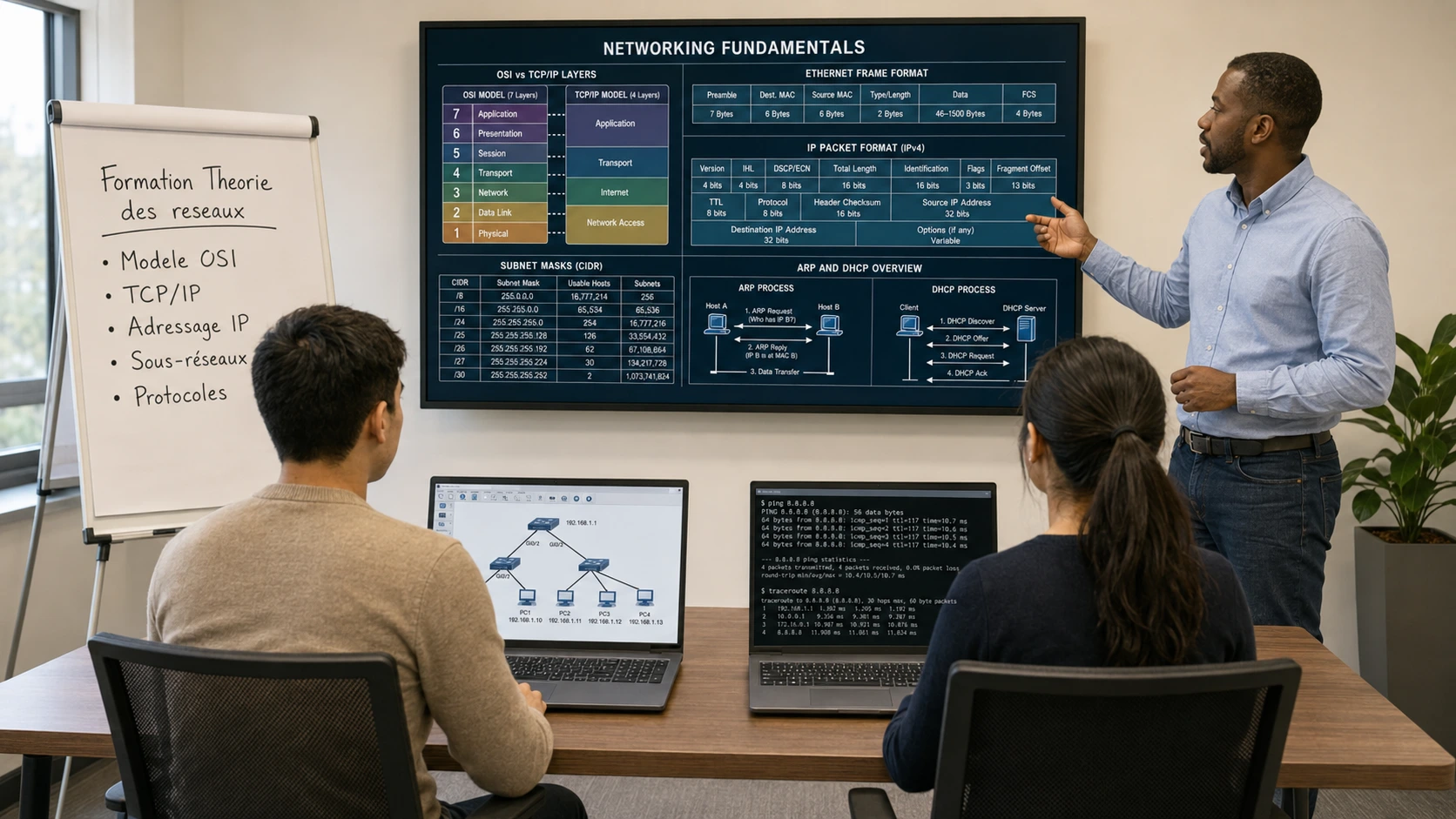
The OSI model is a 7-layer reference model, essentially educational. TCP/IP is the operational 4-layer model that is actually deployed. The two can be mapped to each other. MFE-IT uses both to explain concrete scenarios.
Which fundamental protocols should you know?
The essentials: IP (v4/v6), TCP, UDP, ICMP, ARP, DHCP, DNS, HTTP/HTTPS, TLS, NAT, VLAN 802.1Q. To go further: OSPF, BGP, VXLAN, QoS. Our MFE-IT course covers all these protocols with Wireshark captures.
How long does it take to learn networking theory?
Our Networking Theory course runs over 3 days (21 hours) in a fully tailored format. This volume builds the solid foundations needed before specialising (security, cloud, wireless, etc.).