
AWS DevOps Engineer Training Course: Automate deployment, monitoring and reliability on AWS
Key information
Upcoming sessions
Would you like to schedule this training on a specific date? Contact us by email or via the contact form.
Description of the training: AWS DevOps Engineer Training Course: Automate deployment, monitoring and reliability on AWS
The AWS DevOps Engineer training course is aimed at those who are no longer content simply to deploy: the deployment must now be automatic, traceable, reversible, and you must know within minutes whether it degraded anything.
You build a complete chain, from infrastructure described as code through to progressive release: continuous integration and delivery pipelines, blue-green and canary deployment strategies, automatic rollback on error thresholds, observability that surfaces the right signal rather than every signal. SRE practices — service level objectives, error budgets, blameless incident review — provide the framework that stops automation from becoming a headlong rush.
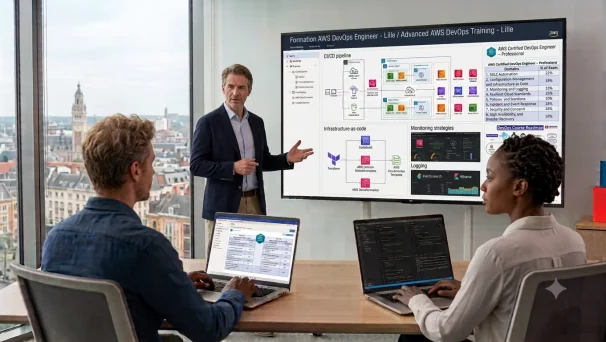
Over 3 days, you spend most of your time building pipelines and deliberately breaking them to observe how they behave. The programme follows the syllabus of the AWS Certified DevOps Engineer – Professional (DOP-C02) certification.
This DevOps course connects with our AWS Solutions Architect Training Course for design, our AWS SysOps Administrator Training Course for operations, and our AWS Developer Training Course on the development side. Containerised deployment ties in with our AWS EKS Training Course, infrastructure industrialisation with our Terraform Fundamentals Training Course, and cost control with our AWS FinOps Training Course. To go further in architecture, our AWS Essential Services Training Course consolidates the blocks a CI/CD pipeline relies on.
Good to know
Sessions are guaranteed from a single registrant (except in cases of force majeure). A preliminary discussion takes place between the participant and/or a company representative to fully take into account the participant’s profile. Assessment: quizzes, role-play and practical exercises. A certificate of completion is issued at the end of the training. This training prepares you for the AWS Certified DevOps Engineer – Professional (DOP-C02) certification (exam not included). This training is part of our Cloud Computing Training Courses catalogue. Discover our other cloud training courses to master architectures, services and best practices on AWS, Azure and GCP. To get started on AWS, we recommend our AWS Cloud Practitioner Training Course as a prerequisite, which lays the foundations of the Amazon Cloud.
Objectives of the training: AWS DevOps Engineer Training Course: Automate deployment, monitoring and reliability on AWS
By the end of the training, participants will be able to:
- Describe and deploy infrastructure as code with CloudFormation and AWS CDK.
- Build a complete continuous integration and delivery pipeline on AWS.
- Implement progressive deployments (blue-green, canary) with automatic rollback.
- Instrument an application and its infrastructure to obtain actionable observability.
- Automate incident remediation and recurring operational tasks.
- Define service level objectives and steer reliability through error budgets.
- Embed security and compliance controls directly into the delivery pipeline.
Prerequisites of the training: AWS DevOps Engineer Training Course: Automate deployment, monitoring and reliability on AWS
Prior hands-on AWS practice is required: you should be able to deploy and administer resources (EC2, S3, IAM, VPC) without discovering the console during the course. The level of the AWS Solutions Architect – Associate or SysOps Administrator – Associate certification is a sound starting point.
Experience with development or scripting (Python, Bash) and familiarity with Git are expected, since a large share of the labs goes through code.
Because every participant is unique, a personalised discussion with our expert allows us to design a training course perfectly aligned with their objectives.
Target audience of the training: AWS DevOps Engineer Training Course: Automate deployment, monitoring and reliability on AWS
- DevOps and SRE engineers responsible for deployment pipelines on AWS.
- Systems and cloud administrators looking to automate the operation of their environments.
- Developers involved in releasing and maintaining the reliability of their applications.
- Technical leads preparing for the AWS DevOps Engineer – Professional certification.
Detailed programme of the training: AWS DevOps Engineer Training Course: Automate deployment, monitoring and reliability on AWS
Infrastructure as code: describe rather than click
- What you gain by no longer configuring by hand: reproducibility, peer review, history. AWS CloudFormation: template structure, parameters, outputs, cross-stack imports. Change sets and drift detection. AWS CDK: describing infrastructure in a real programming language and getting testing and abstraction out of it. Organising an infrastructure repository and managing environments. Lab: deploy a complete environment starting from an empty repository.
Continuous integration and delivery pipeline
- Assembling the chain: CodeCommit or an external Git repository, CodeBuild for builds and tests, CodePipeline for orchestration, CodeArtifact for artefacts and dependencies. Validation stages, quality gates, manual approvals where they actually make sense. Building container images and publishing to Amazon ECR. Multi-account pipelines: build in one account, deploy into another. Lab: from a code change to production, with no manual step.
Deployment strategies and rollback
- Releasing without holding your breath. Blue-green deployment: instant switchover, immediate rollback, the cost of duplication. Canary and progressive deployment: expose a fraction of traffic, measure, continue or retreat. AWS CodeDeploy on EC2, ECS and Lambda. Automatic rollback triggered by a CloudWatch alarm. Decoupling deployment from feature activation (feature flags). Lab: introduce a regression and watch the automatic rollback fire.
Observability: seeing what is actually happening
- The three signals and what each one gives you: metrics, logs, traces. Amazon CloudWatch: custom metrics, Logs Insights, dashboards that are actually useful. AWS X-Ray: follow a request across services and find where the time is lost. Composite alarms and the fight against alert fatigue: alert on the symptom the user sees, not on every twitch of an indicator. Centralised logging in a multi-account environment.
Operational automation and remediation
- Treat repetitive tasks as a defect to be fixed. AWS Systems Manager: automation documents, fleet management, patching, remote command execution. Automatic reaction to events with EventBridge and Lambda. AWS Config: compliance rules and automatic remediation when a resource drifts. Auto scaling and health checks. Lab: detect a non-compliant resource and correct it without human intervention.
Reliability and SRE practices
- Moving from availability you endure to reliability you steer. Indicators, objectives and the error budget: how much downtime can you spend before you must stop shipping? Incident management: detection, mobilisation, communication, restoration. Blameless incident review: what you are looking for, and what you do not write down. Reducing toil in favour of engineering. Resilience testing and controlled fault injection with AWS Fault Injection Service.
Security and compliance built into the pipeline
- Shifting controls upstream rather than enduring them at the end. Dependency and container image scanning with Amazon Inspector. Secrets management: Secrets Manager, Parameter Store, automatic rotation, and why a secret never belongs in a repository. Least-privilege IAM execution roles. End-to-end deployment traceability with CloudTrail. Automatic compliance gates in the pipeline. Capstone workshop: harden an existing delivery pipeline.
Course highlights
- builds a complete chain, from infrastructure as code through to progressive deployment with automatic rollback;
- follows the syllabus of the AWS Certified DevOps Engineer – Professional (DOP-C02) certification;
- devotes around 60% of the time to hands-on work, including deliberately induced failures;
- runs in a group of 1 to 3 participants, which allows work on your own delivery pipeline.
FAQ
Do I need existing DevOps practice to take this course?
A DevOps culture helps, but the essential requirement lies elsewhere: you need to be comfortable on AWS and able to read and write code or scripts. Almost every lab goes through a Git repository and a pipeline. If you administer AWS without ever having automated anything, the course is still accessible — and that is rather the point.
How does this differ from the AWS SysOps Administrator training course?
SysOps covers day-to-day operations: deploying, monitoring, maintaining. DevOps Engineer goes further by automating those operations and industrialising delivery — pipelines, infrastructure as code, progressive deployments, SRE practices. Many participants take one and then the other.
Does the course prepare for the DOP-C02 exam?
The programme follows the syllabus of the AWS Certified DevOps Engineer – Professional certification. The exam is not included in the price: it is taken at an authorised Pearson VUE centre or online.
Is Terraform used during the course?
The programme relies on the native AWS tooling, CloudFormation and CDK, which are what the certification assesses. Terraform can be covered comparatively if the group uses it day to day — this is one of the points we settle during the preliminary discussion.