Python Training Course – Introduction to Programming : From the Basics to Your First Programs
- Price
- Duration
- Number of hours
Our sessions are guaranteed from 1 registered participant (except in cases of force majeure).

Description of the Python Training Course
This “Python – Introduction to Programming” training course introduces you to the basics of Python and programming, from setting up the environment to writing your first programs. You will learn the fundamentals of syntax, data structures, functions, error handling and object-oriented programming. Through numerous practical exercises and guided workshops, you will develop useful and reusable Python scripts. Upon completion of the training, you will be autonomous in writing, testing and evolving simple Python programs adapted to your professional or personal projects.
Format
Remote (recorded sessions).
It is possible to customise the training content to meet the needs of your professional project.
GOOD TO KNOW
This training course includes many exercises (60% practice) for better learning. Sessions are guaranteed from 1 registered participant (except in cases of force majeure). A preliminary interview takes place between the participant and/or a company representative to properly account for the participant’s profile (level, needs, professional context, challenges…).
Assessment: during the training, the trainer evaluates the pedagogical progress of participants through MCQs, role-play scenarios and practical exercises. Participants receive a certificate of skills validation at the end of the training.
Objectives of the Python Training Course
Upon completion of the Python training, the participant will be able to:
- Understand the fundamentals of programming with Python, a versatile, easy-to-learn language used in many fields.
- Install and configure a suitable Python environment (interpreter, IDE/editor, package manager).
- Master basic syntax, data types, operators and control structures (conditionals, loops).
- Learn to structure programs, write custom and reusable functions.
- Discover object-oriented programming (OOP) in Python and learn to design simple classes.
- Be able to develop and run useful Python scripts, with error handling and development best practices.
Prerequisites for the Python Training Course
- No specific technical prerequisites. Basic computer skills (files, navigation) are sufficient.
- A computer with Windows, macOS or Linux and administrator access to install Python.
- Because each participant is unique, a personalised interview with our expert allows us to design a training course perfectly aligned with their objectives, level and professional challenges.
Target Audience
- Absolute beginners in programming wishing to learn Python.
- IT or business staff who need to automate tasks or handle data.
- Professionals wishing to acquire a first skill in software development.
Detailed Programme of the Python Training Course
Introduction to Python and Setup
- Overview of the Python language (interpreted, multi-paradigm: imperative, object-oriented).
- Installing Python and an IDE (Thonny, VS Code, PyCharm) or using notebooks.
- Using the Python interpreter and running your first script.
Syntax, Variables and Basic Types
Identify business use cases suited to pre-built models. Analyse documents using the Read, Layout or General Document models. Process specialised documents (financial, tax, identity documents).
Control Structures
- Conditional statements (if, elif, else).
- Loops (for, while) and iteration management.
Data Collections
- Lists, tuples, dictionaries and sets: creation, access, modification.
Functions and Modularisation
- Writing functions with parameters and return values.
- Concepts of variable scope and function documentation.
Error and Exception Handling
- Detecting and handling exceptions to make programs robust.
Object-Oriented Programming (OOP)
- Defining simple classes, attributes, methods and constructors.
- Concepts of inheritance and encapsulation.
Input/Output and Files
- Reading and writing text files, data manipulation.
Practical Workshops and Mini-Projects
- Interactive scripts (calculations, text processing, files).
- Final mini-project: a complete program using concepts learned.
Related Training Courses

JMeter Performance Testing Training – Simulate, Measure and Optimise your Web Applications at Scale
Master Apache JMeter to test the robustness and scalability of your systems.
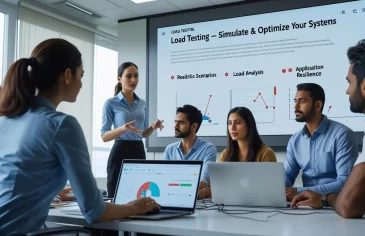
Load Testing Training – Simulate Real User Behaviour to Evaluate the Limits of your Applications
Learn to anticipate failures, detect bottlenecks and to validate the robustness of your systems.
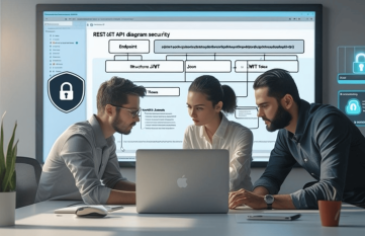
REST API – Create, Expose and Integrate Secure and Scalable Web Services
Master the best practices of architecture, development and consumption of RESTful APIs.
Would you like to know about upcoming sessions ?
Would you like to schedule this training course on a specific date ? Contact us by email or by filling out the contact form.